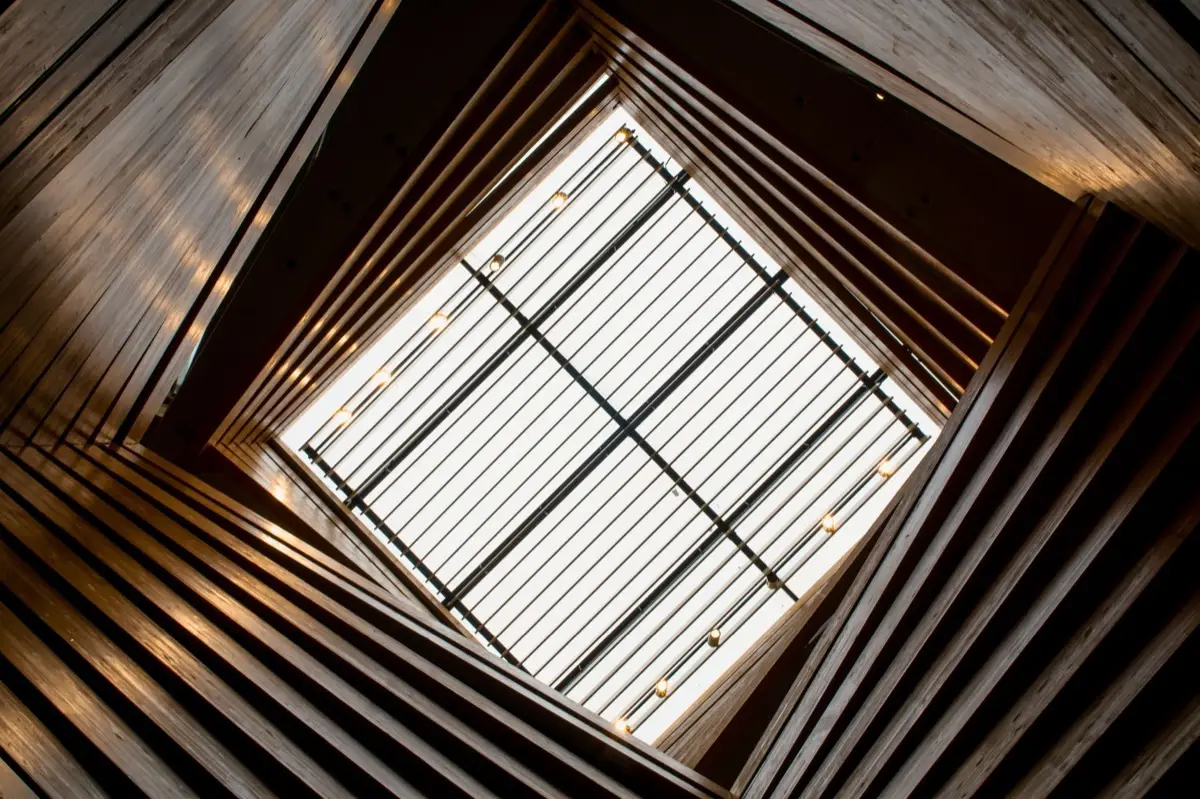
On a retrofit, the skylight is the small half of the bill. The unit is a manufactured product with a published price. Everything around it is carpentry, roofing, drywall and paint, done by different people, and that is where the number goes.
Which is why two houses on the same street get quotes nothing alike for what looks like the same job.
New hole or in-kind swap: the fork that doubles the number
Before any product decision matters, one question sets the order of magnitude.
Replacing in kind. A skylight is already there, the curb is sound, a new unit goes into it. Roof work only. Nothing inside the house is opened, and the shaft, drywall and paint that already exist keep existing.
Cutting a new opening. Now you are buying a hole in the deck, a header where a rafter was cut, a shaft from the deck down to the ceiling, insulation, drywall, corner bead, paint, and a repair to the roof covering around the new curb.
Published guides bracket the framing-and-opening adder at several hundred to fifteen hundred dollars over a standard install, and price the lined shaft higher still — one puts the shaft alone above what most people budget for the whole project. Both came off search snippets rather than pages we could open, so treat them as bracketing and not as quotes. The ratio is the durable part: on a new opening the interior finish can cost more than the skylight.
| Line | What it is | Why it moves |
|---|---|---|
| The unit | Glass, frame, factory seals | Fixed cheapest, solar-venting highest |
| Flashing kit | Made for that unit and that roof covering | Tile and metal kits cost more than shingle |
| Roof labor | Cut, curb, flash, reintegrate the courses | Pitch, height, access |
| Framing | Header, trimmers, cut rafter | Whether a rafter had to be cut at all |
| Shaft and drywall | Build, insulate, board, tape, paint | Attic depth, splayed or straight, ceiling height |
One contractor cost calculator puts labor at half to two-thirds of an add-a-skylight total and material the rest, which explains why choosing a cheaper unit barely moves anything.
The framing line has a shortcut in it. A unit sized to fit between rafters at standard spacing cuts no structural member at all, so ask for the widest unit that fits the bay before you ask for the one from the showroom. The moment a rafter is cut, a header and a structural detail arrive with it.
Curb mount and deck mount, and why the guides disagree
Search this and you will find sources flatly contradicting each other about which costs less. They are answering different questions.
Curb mount sits on a built-up wooden curb standing proud of the roof plane. The unit is simpler and cheaper. The curb is carpentry somebody has to build and flash.
Deck mount fastens to the deck itself, sits lower, and arrives as a system: a pre-attached deck seal, an adhesive underlayment over it, then the metal flashing kit. It costs more; there is no curb to build.
So on a new opening it is genuinely close and depends on the crew. On a replacement there is no comparison — an existing curb takes a curb-mount unit, and forcing a deck-mount detail into it means rebuilding the roof around the hole.
One part is code rather than preference. IRC R308.6.8 requires a unit skylight on a roof pitched less than 3:12 to be mounted on a curb extending not less than 4 inches above the plane of the roof, unless the manufacturer's instructions say otherwise. On a low-slope roof the curb is not a style choice.
Fixed, venting, solar-venting, and the one that skips the shaft
Fixed is the floor: sealed glass, no moving parts, nothing to service. Manual venting adds an operator you crank. Electric adds a motor, a control and a rain sensor that shuts the unit when weather arrives. Solar-powered venting adds a panel and a battery so nothing has to be wired.
The ordering is stable even as the figures move: fixed, manual, then powered, with blinds and controls priced again on top. The venting money buys a mechanism on a roof, and mechanisms are what needs somebody on a ladder in year twelve.
The option nobody quotes unless asked is a tubular daylighting device — a dome, a reflective tube through the attic, a diffuser in the ceiling. No shaft, no framing beyond the tube, a trim ring instead of drywall. It buys daylight and not a view, which for a hallway or a windowless bathroom is the whole requirement, and it deletes the two most expensive rows in that table.
The tax credit question, answered
Solar-powered venting has been sold for years on the strength of a federal credit, and the arithmetic making it competitive with electric depended on that credit. That credit is gone. Section 70506 of Public Law 119-21, enacted 4 July 2025, ended the Residential Clean Energy Credit at 26 U.S.C. 25D for expenditures made after 31 December 2025, and the IRS carries the same cutoff on its page for the credit. Separately, and earlier, VELUX told its installer network that after reviewing US tax law it could not certify that any solar powered skylight, accessory or installation cost qualified under 25D, and stopped promoting the section as an incentive.
This is information rather than tax advice. A bid that has already subtracted a federal credit is quoting a rule that expired, so price solar venting against electric on what they cost. What the 2025 law did to both home energy credits is set out on the roof and taxes page.
Factory flashing kit or site-formed metal
This is the quality fork, and it is invisible once the shingles are on.
A factory kit is made for that unit, that size and that covering, and goes on in a defined order with the courses. Manufacturers condition the water side of their warranty on it: VELUX covers skylight and flashing for ten years on material and workmanship, twenty years on the seal between the panes and five on blinds and controls — and the installation cover exists only where their flashing kit was bought and installed with the unit.
Site-formed flashing is bent on site from coil. From a sheet metal tradesperson on an odd curb or a tile roof it can be fine work. Ordered as a saving on a standard unit that has a kit available, it is a warranty traded for the price of the kit.
Either way the failure point is the same: the head of the unit, where the whole roof plane above hands its water to one horizontal edge, and the apron at the bottom. A skylight is a layered flashing assembly like every other detail up there, and the rules — laps, order, what may never be sealed with caulk — are the ones in flashing on a roof. Ask which kit, by name.
One more spec: IRC R308.6.9 requires unit skylights and tubular devices to be lab tested and labeled with manufacturer and performance grade under AAMA/WDMA/CSA 101/I.S.2/A440. An unlabeled unit is not a bargain.
Who is allowed to do which half in California
A skylight retrofit crosses a trade boundary mid-job. Whatever credential your state issues for roofing, or does not issue, it was written around weatherproofing rather than around finishing a room.
C-39 is the CSLB roofing classification, and here is the check most people miss: a C-39 must carry workers compensation whether or not it has employees, so an active roofing license with an exemption on file is a red flag. Your down payment is capped at ten percent or a thousand dollars, whichever is less. If the contractor turns out to have been unlicensed, you can sue to recover everything you paid, however good the work was.
California draws the line where you can see it. The C-39 roofing classification is written around sealing, waterproofing and weatherproofing a structure — the curb and the flashing — while gypsum board, taping and texturing sit in C-9, a separate classification. On the face of those definitions, whoever made the roof watertight is not the one who finishes the inside of the shaft. Ask who is doing the drywall return, and under what license.
When the skylight is the line the carrier strikes
Skylights get denied more often than roofs do. A unit fogged at the seal, or leaking at a twenty-year-old curb, reads to an adjuster as age and wear rather than storm — so the re-roof is approved and the skylight in the middle of it is not. What you can undo once that letter arrives, with a contract already signed, is state law.
California ties every cancellation window to the day you sign, not to what your insurer decides - so a denial three weeks later leaves you with no statutory way out. You get three days normally, five if you are a senior citizen, and seven only where a disaster has actually been declared by the President, the Governor or your local executive officer. The notice must be twelve-point boldface, immediately next to where you sign.
"We'll add a skylight while we're up there"
The upsell is often sensible: the roof is open, the crew is there, and a unit added during a re-roof costs less than the same one added later. It turns into something else when the extra is presented as free because your deductible is being handled.
California has no contractor-specific rule against a roofer eating your deductible, which is unusual for a big storm state - the section listing prohibited acts in home improvement contracts says nothing about it. That is not permission. A roofer who quietly covers your share while billing the carrier the full amount is assembling a false claim, and that is a crime under Penal Code section 550 for the roofer and for you.
What to require in writing
| Line item | What it has to say |
|---|---|
| Scope | New opening, or replacement into the existing curb |
| Unit | Make, model, size, fixed or venting, glazing |
| Mount | Curb or deck, and who builds the curb |
| Flashing | Manufacturer kit by name, for your roof covering |
| Framing | Whether a rafter is cut, and the header detail |
| Shaft | Built, insulated, drywalled, taped, painted - or not |
| Ceiling and paint | In scope or excluded, by name |
| Permit | Who pulls it |
| Warranty | Unit warranty and workmanship years, separately |
The row that settles most arguments is the shaft. A bid that stops at the roof deck is not wrong, it is a different job — and usually the cheaper of the two you are holding.
Si prefieres que te expliquemos el presupuesto del tragaluz en español, parte por parte, lo hacemos sin problema.
Bottom line
One warning first. Cold glass in a warm humid room drips, runs down the shaft and stains the drywall exactly where a leak would, and replacing a sound skylight fixes that for about a week. If your unit is wet, find the leak first — a written roof inspection settles leak-or-condensation faster than any argument held in the room.
Then price the hole rather than the skylight. A like-for-like swap into a sound curb is one of the cheapest improvements on a roof; a new opening through a finished ceiling is a carpentry and paint project with a skylight in it. Get the mount type, the flashing kit and the shaft scope in writing, ignore any federal credit in a bid, and remember the low bid is usually the one that stopped at the deck.
Chula Vista Roof Pros installs and replaces skylights alongside roof replacement, roof leak repair and roof inspections across Chula Vista and the South Bay of San Diego County. Call (844) 542-8467 and we will tell you which of the two jobs you actually have before anybody quotes a number.
Ready for a free quote in Chula Vista?
Chula Vista Roof Pros — free estimate, clear scope, no pressure. Use the form on this page or jump to the homepage quote.
Related services in Chula Vista
Chula Vista Roof Pros money pages — go straight to the service you need.
- Roof Replacement →
A replacement quote here should open with a question about your address rather than your color preference. The framing under you was sized for a particular weight, and that number caps every choice that follows.
- Roof Leak Repair →
Leaks arrive from different places depending on which half of the city you live in, and guessing wrong wastes a service call. We ask what the house is before we climb, then follow the water instead of resealing whatever happens to look tired.
- Roof Inspections →
We run two different inspections in this city and we tell you which one you are getting before we arrive. They hunt for different things, because the two halves of Chula Vista hide their problems in completely different places.
- Storm Damage Roof Restoration →
Storm work here is a narrow category and we would rather define it honestly than sell it broadly. Two kinds of event actually remove roofing in the South Bay, and neither of them is the one most storm advertising gets written about.
- Hail Damage Roof Repair →
We argue against our own service on this page. The coastal South Bay does not get damaging hail at any meaningful frequency, and nearly every roof we are called out to inspect for it turns out to have something entirely different wrong.
Frequently asked questions
How much does a skylight cost with installation?
There is no single answer because there are two different jobs hiding behind one phrase. Swapping a unit into a curb that already exists is a half-day on the roof and nothing else. Cutting a new opening adds framing, a lined shaft, drywall, paint and a patch in the roof covering, and published totals for that version routinely run several times the in-kind swap. Any quote produced from your address alone is guessing which job you have.
Is it cheaper to replace an existing skylight than to add a new one?
Much cheaper, and the gap is bigger than most homeowners expect. A like-for-like replacement into a sound curb touches nothing inside the house: no framing, no header, no drywall return, no paint, no ceiling repair. Every one of those lines exists on a new opening and several of them are billed by other trades. If your existing skylight is fogged or leaking, replacing in kind is the cheapest daylight you will ever buy.
Do curb-mounted or deck-mounted skylights cost more to install?
Published guides say the opposite things, and both are right about different situations. Curb mount looks cheaper because the unit is simpler, but somebody has to build the curb, which is carpentry plus flashing. Deck mount looks pricier because the unit is more expensive, but it drops into the deck with a factory flashing kit and no curb to build. On a replacement into an existing curb the argument disappears entirely: you buy the curb-mount unit and change nothing else.
How much more is a venting skylight than a fixed one?
A venting unit adds an operator, a control and a rain sensor, and solar-powered venting sits above manually cranked venting. The ordering is stable even though the figures move: fixed is the floor, manual venting above it, electric and solar-powered venting above that, with blinds and controls priced separately again. What that money buys is not just fresh air.
It is a mechanism, a battery and a motor on a roof, which is a maintenance item a fixed unit does not have.
Is there still a federal tax credit for solar-powered skylights?
No. Solar powered skylights and their blinds were claimed under the Residential Clean Energy Credit at 26 U.S.C. 25D, and section 70506 of Public Law 119-21, enacted 4 July 2025, closed that credit to expenditures made after 31 December 2025.
The statute treats an expenditure as made on the day the original installation is finished, so money put down in 2025 against a unit fitted in 2026 does not reach back over the line. The IRS states the same cutoff on its own page for the credit.
Separately, and earlier, VELUX told its installer network it could not certify that solar powered skylights qualified under 25D at all and stopped promoting it. This is information rather than tax advice, but a bid that discounts itself with a federal credit is quoting a rule that has expired.
Why do skylights leak?
Almost never through the glass. Water gets in at the head of the unit, where the roof above delivers everything it collects to the top edge, and at the curb.
The other half of reported skylight leaks are not leaks at all but condensation running off cold glass onto the shaft, which is a ventilation and insulation problem wearing a leak costume. Both look identical from a wet ceiling, which is why the diagnosis happens on the roof rather than in the room.
Local context
How this applies in Chula Vista, CA
Every article here is written from roofing work done in Chula Vista and the South Bay of San Diego County, so the numbers reflect local labour, permit and material costs rather than a national average. Your own job can land either side of them depending on access, the condition of what is already there, and the materials you pick — high-temperature self-adhered underlayment rated for tile applications, concrete roof tile dead load carried on engineered truss framing, spaced one-by board sheathing replaced in half-inch structural plywood.
The way to turn any of this into a real answer is to have someone look at your actual situation. The free estimate is free, itemized and written down, with no deposit and no obligation. Call (844) 542-8467 or start on the Chula Vista Roof Pros homepage.
Areas Chula Vista Roof Pros covers
Chula Vista first, then the surrounding communities of the South Bay of San Diego County. Each has its own page with local detail rather than a copy of this one:
- National City, CA — San Diego County, population 56,173
- Imperial Beach, CA — San Diego County, population 26,137
- Coronado, CA — San Diego County, population 20,192
- Bonita, CA — San Diego County, population 12,917
- Sunnyside, CA — San Diego County, population 4,627
- Lemon Grove, CA — San Diego County, population 27,627
Or jump to the full list of Chula Vista services.
More from the Chula Vista Roof Pros blog
- Shingles Roof Coating: What It Does to an Asphalt Roof in Chula Vista
Coating asphalt shingles is sold everywhere and advised against by the people who make the shingles. What a coating does to a lapped roof, to your warranty, and to a future hail claim in Chula Vista, CA.
- A Roof With an Ice Dam in Chula Vista: A Heat Problem, Not a Gutter Problem
What causes an ice dam, what one looks like from the driveway, why the water ends up on your Chula Vista, CA ceiling, and the fix order that works: air seal, insulate, ventilate.
- Roof Underlayment Types in Chula Vista: Felt, Synthetic, Peel-and-Stick
Felt, synthetic and self-adhered underlayment compared for Chula Vista, CA roofs — what the ASTM numbers mean, which ones are real standards, and the laps and fasteners that decide whether any of it works.
The Chula Vista Roof Pros Team
roofing specialists serving Chula Vista, CA
Written by the Chula Vista Roof Pros team — insured roofing pros serving Chula Vista, CA and the surrounding area.